
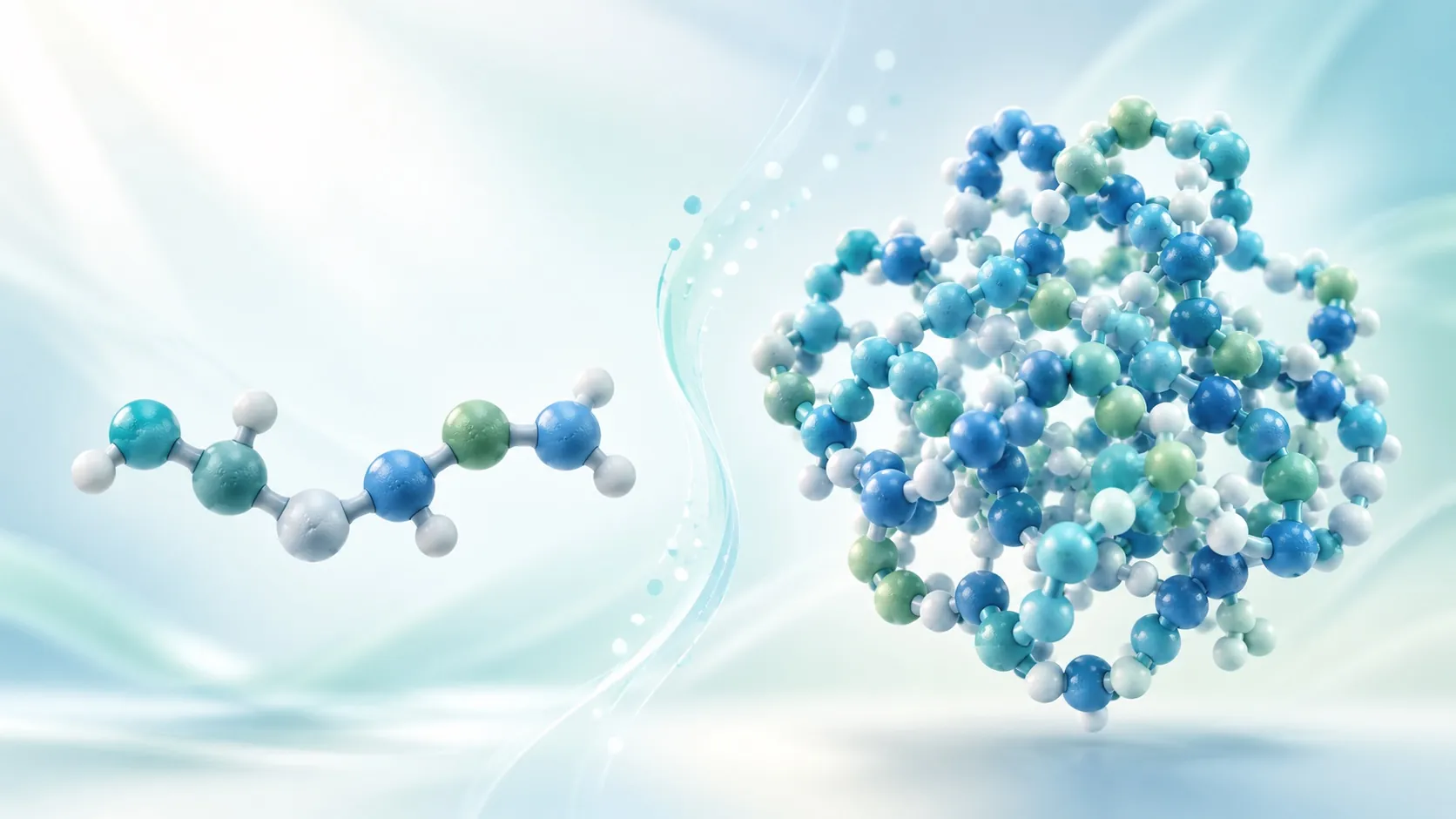
Peptides and proteins are closely related molecules. Both are made from amino acids joined together by peptide bonds. The difference is not always as simple as drawing a fixed line between “small” and “large.” Chain length is one common distinction, but researchers and reference systems may use different cutoffs. Structure and biological context also matter.
Understanding the relationship between peptides and proteins makes scientific writing easier to follow. This guide explains what they share, how they are commonly distinguished, and why the labels do not always fit into a simple rule.
What do peptides and proteins have in common?
Both peptides and proteins are chains of amino acids. A peptide bond connects one amino acid to the next, creating a molecular backbone. The order of amino acids is called the sequence, and different amino acids contribute different chemical properties through their side chains.
A helpful analogy is a line of building blocks: the blocks are amino acids, and the links between them are peptide bonds. A short line and a long, folded structure may look different, but they are built from the same basic units. In real molecules, the sequence and chemical properties of each amino acid also influence how the chain can interact and organize.
The term polypeptide is often used for an amino acid chain, especially when discussing its structure or formation. A protein may consist of one or more polypeptide chains organized into a larger molecular structure. This shared foundation is why peptide and protein terminology can overlap in biochemistry.
How are peptides and proteins commonly distinguished?
One common approach is to compare the length of the amino acid chain. Peptides are generally described as shorter chains, while proteins are usually longer and more structurally organized. However, there is no single chain-length cutoff that is used in every field or reference source.
For example, some biochemistry resources describe peptides as chains of roughly 2 to 50 amino acids. Other classification systems define smaller subgroups, such as oligopeptides, with their own approximate ranges. The U.S. National Library of Medicine’s Medical Subject Headings (MeSH) describes peptides broadly and notes that proteins are larger versions that can form complex structures.
These ranges are practical conventions, not universal borders in nature. A molecule does not suddenly become a fundamentally different kind of material when one amino acid is added. The terminology depends on the context, the convention being used, and sometimes how the molecule is produced or studied.
When reading a paper or product description, it is more accurate to look at the specific definition being used than to assume every author follows the same cutoff.
Why does protein structure matter?
Amino acid chains can take on three-dimensional shapes. The sequence influences which structures may form because amino acids have different side chains and chemical characteristics. In proteins, folding and organization can create a more complex structure than a simple linear chain.
Researchers often describe protein structure at several levels. The primary structure is the sequence of amino acids. Secondary structure refers to local patterns in the chain, such as alpha helices or beta sheets. Tertiary structure describes the overall three-dimensional arrangement of a single chain, while quaternary structure refers to the organization of multiple chains when they form a complex.
These levels are useful ways to talk about molecular organization, but they do not mean every protein is a rigid, permanent shape. Molecules can be flexible, and their structures may vary with their environment or with the conditions under which they are examined. Peptides can also form specific structures; being shorter does not mean a chain is always shapeless or simple.
Is a peptide just a small protein?
Not exactly. “Peptide” and “protein” are related labels, but they do not always communicate only size. In some contexts, researchers may call a short chain a peptide because of its length. In other contexts, a chain may be discussed as part of a protein or as a protein in its own right based on its biological context and how it is produced.
The boundary is especially fuzzy for short proteins and longer peptides. Scientific naming conventions, database classifications, and regulatory definitions may not use identical criteria. That is why it is useful to check how a source defines its terms rather than relying on a single universal rule.
A careful description may include several details at once: amino acid sequence, chain length, whether the molecule is linear or cyclic, structural information, and the system in which it was identified or studied. That information is often more informative than the label “peptide” or “protein” by itself.
Do peptides and proteins have different biological roles?
Both peptides and proteins are found across biological systems, and both can be involved in a wide range of processes. Some peptides serve as signals or fragments of larger molecules. Proteins can have structural, catalytic, transport, or regulatory roles, among others. These examples describe broad categories; they do not mean every peptide or protein has the same kind of role.
A molecule’s biological role depends on its particular identity and context. Its sequence, structure, location, interactions, and the system in which it is studied all matter. The broad label alone—peptide or protein—does not explain what a specific molecule does.
This distinction matters in scientific communication. A finding about one peptide does not automatically apply to all peptides, and a description of a protein family does not establish the properties of every member of that family. Researchers connect claims to specific molecules and evidence.
Why does the distinction matter in research?
The distinction helps researchers describe what they are studying and choose appropriate methods. A short chain and a large folded protein may require different approaches for analysis, synthesis, structural characterization, or comparison. A paper’s terminology gives readers an initial clue about the molecule, but the methods and molecular details provide the fuller picture.
When reading a peptide or protein study, look for:
- The molecule’s exact name or sequence
- Its amino acid length and any modifications
- Whether it is linear, cyclic, or part of a larger structure
- How the researchers identified or characterized it
- Which biological or experimental model was used
- What the study actually measured
These details help distinguish a general explanation from a specific research finding. They also reduce the chance of assuming that conclusions about one molecule apply to another simply because both are called peptides or proteins.
How do peptides and proteins relate to wellness research?
Peptides and proteins are part of the chemistry of living systems, so both appear in research that aims to understand biological organization and communication. This makes them relevant to broad scientific discussions about health and wellness. But the fact that a molecule is natural, biologically active, or scientifically studied does not establish a wellness benefit for a product containing or referencing it.
A research finding must be interpreted in light of the exact molecule, the study model, the method, and the measured result. A structural description is not an outcome, and a biological role is not proof that a particular product produces a health effect. Careful language keeps the distinction clear between basic science and claims about people.
This article is educational. It explains scientific terminology without describing product use or claiming health outcomes.
Short FAQ
What is the main difference between a peptide and a protein?
Peptides are generally shorter amino acid chains; proteins are generally longer and more structurally organized. The exact cutoff varies by source.
Are proteins made from peptides?
Proteins are made from one or more amino acid chains linked by peptide bonds. “Peptide” and “polypeptide” describe chains within this shared molecular framework.
Can peptides have a three-dimensional structure?
Yes. Peptides can adopt structured shapes, though their structure and flexibility depend on the specific molecule and its conditions.
Is there a universal amino acid cutoff between peptides and proteins?
No. Different scientific references and classification systems use different conventions.